
Welcome, friends, to the intriguing world of Kingdom Scouts, where we embark on a quest to explore terra incognita. Today, we continue to investigate if Seeking the Kingdom of God could be the key to unlocking the modern problem of stress.
In our previous entry, we discovered three potential avenues that could lead us to this holy grail. Now we shall delve deeper into the first one: transcending our minds. It is no secret that our minds play a significant role in our experience of stress. Therefore, it stands to reason that transcending the mind could alleviate, or even extinguish, this pernicious affliction.
But, what does transcending the mind truly mean? Is it an enigmatic philosophical concept or a spiritual idea that eludes the grasp of us, STEM-trained, pasta-loving folks who are accustomed to the prosaic ways of the scientific method?
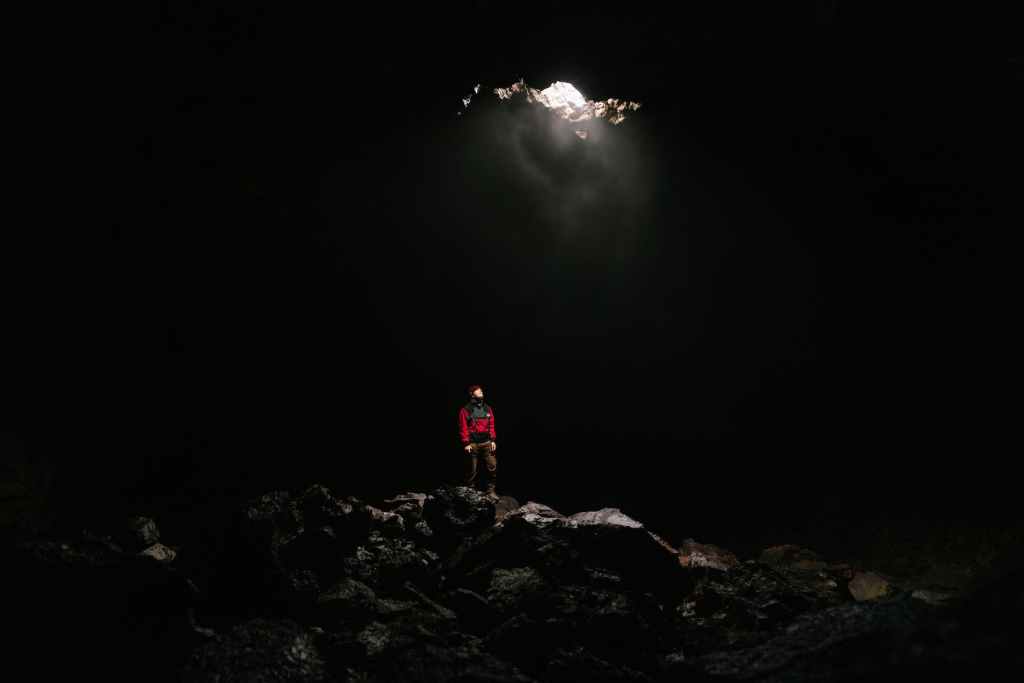
As in all our voyages of discovery, we fear not the unknown. We embrace it with open hearts and curious minds, especially in this entry when we will be exploring a very peculiar kind of Cave. We will take a look at what scientists and philosophers have to say on the matter and we will put special attention to a strange idea where they both agree. Let us delve into the depths of this transcendental terrain and seek the wisdom it holds.
The Proposal
The main source of this investigation comes from Matthew 3:2. Therein we encounter the formidable figure of John the Baptist preaching in the desert:“Repent,* for the kingdom of heaven is at hand!”
As we learned in the previous entry, the Greek word used in this clarion call to action is “Metanoia,” which can be interpreted in two distinct ways. It can mean “transform your mind,” or it can mean “go beyond your mind.”
The Baptist says the mind won’t cut it for seeking The Kingdom, but the call to action suggests it’s still within reach. If not the mind, then what? The natural next question arises: what’s wrong with the mind?
What is wrong with our minds?
We now take a fast trip into the vast and intriguing world of cognitive science, and we face the notion that reality is far too vast, and our minds are far too limited by our past experiences and biases to fully comprehend it. .
The eminent neuroscientist and author, David Eagleman, argues in his book “Incognito: The Secret Lives of the Brain,” that our brains can’t process all the information present in the world around us. Instead, they sift through sensory input, focusing only on what is most relevant to us.
In his other book “The Brain: The Story of You,” Eagleman proposes that our perception of reality is shaped by our past, and our perception of reality is always limited and shaped by our previous experiences, rather than the present moment.
Moreover, cognitive psychologist Donald Hoffman asserts in his book “The Case Against Reality,” that our minds create simplified models of reality that are useful for our survival, but do not necessarily reflect the true nature of the world. Thus, our perception of reality is always limited by our mental models of the world, which may not be accurate or complete.
So, friends, it seems that our minds can only perceive reality partially, and they do so through filters and interpretations that are influenced by our past experiences and mental models. Could this be the reason why we need to transcend our minds to find The Kingdom of God?
Choiceless awareness
As we delve deeper into the topic, we turn to the world of philosophy and spirituality to gain a fresh perspective. There, we encounter the wise teachings of Jiddu Krishnamurti, a spiritual teacher and philosopher who believed that the limitations of the mind can be transcended through self-awareness and inquiry.
Krishnamurti emphasized the importance of “Choiceless Awareness,” a state in which we are fully present in the moment, free from biases and judgments that cloud our perception of reality. He believed that only when our minds are free from conditioning, can we experience reality as it truly is, unfiltered by the mind’s limitations.
Another prominent spiritual teacher, Eckhart Tolle, also agrees with Krishnamurti’s views on the nature of consciousness and the limitations of human perception. In his book “The Power of Now,” Tolle argues that our minds are constantly preoccupied with thoughts of the past and future, limiting our ability to fully experience the present moment.
Despite coming from different disciplines, both Krishnamurti and Tolle reach the same conclusion as Eagleman and Hoffman – that the capacity of our minds to perceive reality completely is limited by the very structure of our thinking, which is always bound by memory, knowledge, and experience.
Plato’s cave
The last piece of evidence of this investigation leads us into the wisdom of the ancient Greek philosopher Plato, where we find a unique perspective on transcending the mind.
In his famous Allegory of the Cave, Plato describes how humans are like prisoners chained in a cave, with only shadows on the wall to represent the reality outside. Plato believed that true knowledge and understanding could only be achieved by freeing oneself from these chains and ascending to the realm of the Forms, where true reality exists.
In this sense, transcending the mind for Plato was not about rejecting the mind, but rather about using it as a tool to access a higher level of understanding. Through reason, contemplation, and the pursuit of knowledge, one could lift oneself out of the darkness of ignorance and into the light of truth.
This echoes the concept of choiceless awareness, as both suggest a need to move beyond the limitations of our minds and embrace a more profound reality.
Putting all together
Summarizing, our minds create a map of reality, which is a very useful map, but not the real thing, and it is limited by our past experiences and biases. The Kingdom lies beyond the map, in the realm of reality created by God. The Allegory of the Cave reminds us of the importance of breaking free from our limited perceptions and striving towards a state of “choiceless awareness.”
So, can we still use our minds to seek the Kingdom? The answer seems to be yes, but only with a free mind, trained to perceive reality in a new way. But how can STEM-trained, pasta-loving folks like us achieve this kind of mind? Are other types of perception available? In the next entry we’ll take a look at what science has to say about this topic.

 Kingdom Scouts
Leave a comment